About the Artist Emil Hermann
History
Emil Hermann was born in Vienna, Austria in 1871 to a French mother and an Austrian father who worked as an engineer and initially did not view art as a suitable profession for his son. However, Hermann’s natural talent became evident at an early age, and he was eventually permitted to pursue formal training at the Royal Academy in Vienna. He continued his studies at the National Art Institute in Budapest and later at the Rembrandt Art Institute in Amsterdam, where exposure to a broad range of European artistic traditions helped shape his technical discipline and symbolic style.
At the age of nineteen, Hermann emigrated to the United States to continue his artistic education at the prestigious Pennsylvania Academy of Fine Arts. Shortly after his arrival, he opened his first studio in Philadelphia and became a United States citizen in 1890. His early years in America were marked by strong community involvement and artistic leadership he helped organize and served as the first president of the Ohio Brush and Pencil Club and later became president of the Dayton, Ohio Art Club, contributing significantly to the development of a regional art center.
A Dayton art dealer hosted Hermann’s first solo exhibition, which led to mural commissions and increasing recognition as one of the leading portrait painters in the region. In 1919 he married Minnie Roberts, and during the following years he began spending more time in Wichita Falls, Texas, drawn by the economic growth and cultural energy of the area during the Burkburnett oil boom. By 1933 he sold his Ohio home and established a permanent studio in Wichita Falls, where he would live and work for the remainder of his life.
Hermann’s artistic style combined classical realism with emotional depth and narrative character. He became widely known for his ability to portray not only the physical likeness of his subjects, but also their personality, social presence, and inner temperament. Over the course of a seventy-five-year career, he completed more than one thousand portraits, murals, and landscapes, many of which remain in private collections and public institutions throughout Texas, Louisiana, and Oklahoma. Emil Hermann continued painting well into his later years and passed away in his Wichita Falls studio in 1966 at the age of ninety-five.
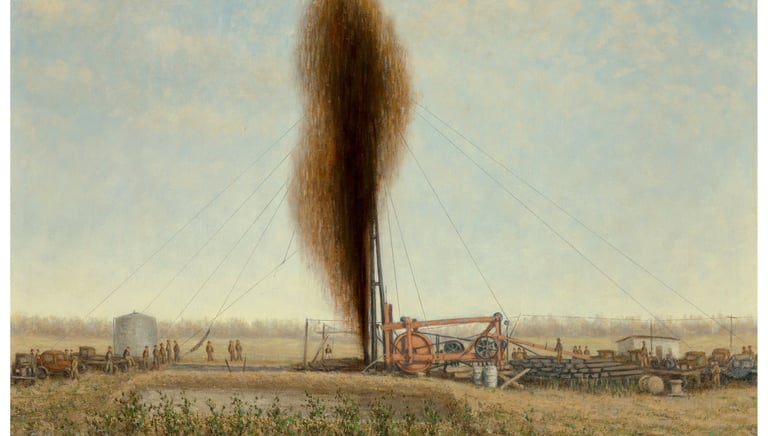
A painting Emil made while in Texas
People and Cultural Influence
Throughout his life and career, Emil Hermann was deeply shaped by the artistic and cultural environments in which he lived. His early years in Europe exposed him to academic art traditions, classical portraiture, and emerging modern movements, giving him a strong technical foundation and an appreciation for disciplined craftsmanship. His time studying and working across Vienna, Budapest, and Amsterdam placed him in contact with artists, educators, and cultural thinkers who influenced both his style and his understanding of art as a reflection of society.
When Hermann later settled in the United States, he became an active figure in regional art communities, helping organize associations, mentoring younger artists, and contributing to the development of local creative circles. The people he encountered from fellow painters to civic and cultural leaders played a significant role in shaping his artistic voice and the subjects he chose to portray. His work reflects not only his personal skill and discipline, but also the broader cultural conversations and communities that surrounded him throughout his life.